Scale Content Production: 10 to 200 Articles with Bulk Mode
Learn how to use Bulk Mode to scale content production from a handful of articles to hundreds per month while maintaining quality and SEO effectiveness.
Adam Yong
Founder & CEO

We know that the goal of Scaling Content Production with Bulk Mode: From 10 to 200 Articles Per Month sounds like a massive logistical challenge.
The true bottleneck for most marketing teams is almost always execution rather than strategy.
Our founder at Agility Writer, Adam Yong, experienced this exact limitation during his two decades as an SEO professional.
Processing each article individually simply cannot scale without a massive increase in headcount.
We built Bulk Mode to completely change this traditional production equation.
This approach allows marketing agencies to queue hundreds of pieces for simultaneous generation.
Our system assigns specific keyword targets and search intents to every single draft.
The result is a highly efficient pipeline that handles 200 articles a month without sacrificing ranking signals.
We will now break down why volume matters and explore a practical workflow for scaling your publishing calendar.
Why Scale Matters for SEO
Google’s December 2025 Core Update proved that search engines reward demonstrated topical authority above all else. We observed that sites with deep, comprehensive coverage consistently outperformed competitors with thin content.
A website with 15 articles about home renovation in Malaysia cannot compete against a platform featuring 150 well-structured guides. Our internal data shows that establishing broad coverage quickly gives early movers a compounding traffic advantage.
| Metric | Low Volume (10 to 20 Articles) | High Volume (150+ Articles) |
|---|---|---|
| Topical Authority | Weak coverage of core topics | Comprehensive cluster saturation |
| Traffic Potential | Limited to a few primary keywords | Captures thousands of long-tail variations |
| E-E-A-T Signals | Minimal structural connections | Strong internal linking networks |
Scaling content production is definitely not about flooding the internet with low-quality spam. A dedicated AI SEO writer focuses on building targeted, helpful coverage much faster than manual typing allows.
The market rewards brands that comprehensively answer every user question within a specific niche. Our successful users treat this volume as a structural moat against their closest competitors.
How Bulk Mode Works
Processing massive batches requires a specialized, automated infrastructure. We divide this process into distinct, manageable steps for content marketers.
Queue-Based Processing
Agility Writer operates on a highly efficient queue system for rapid generation. We allow you to upload a CSV file with up to 50 articles using the Bulk 1-Click Mode.
Users who need even more capacity can utilize the Advanced Mode queue to handle 200 articles. Our platform sequentially processes each piece with its own assigned primary and secondary keywords.
This queue approach means an SEO specialist can prepare a full month of content during a single afternoon session. We handle the heavy lifting of generation while you focus on editorial review and strategy.
- Target Word Count: Specify exact lengths ranging from 500 to 5,000 words.
- Output Language: Select from over 15 options including English, Malay, and Chinese.
- Internal Linking: Automatically add Silo Links to group related content together.
- Structure Formatting: Generate diverse layouts with tables, quotes, and bullet points.
Batch Settings vs. Individual Overrides
Setting defaults at the batch level saves hours of tedious configuration. We give you the flexibility to override these global parameters for any specific article.
Most articles in a batch will naturally share the same brand voice, target audience, and linking strategy. Our interface makes it easy to apply the GPT-4o model universally while selecting a different structure for a single comparison post.
This balance between automation and precision is essential for SEO success. We see agencies set a standard 1,500-word informational format for the batch, then customize a 2,500-word product review with a data table.
- Word Count Adjustments: Bumping a standard guide up to 3,000 words for deeper coverage.
- Structure Changes: Adding a detailed product comparison table to a specific review.
- Data Sourcing: Forcing in-depth academic research for a complex technical topic.
- Tone Shifts: Changing a casual blog tone to a highly professional corporate voice.
Quality Controls at Scale
Generating hundreds of articles without strict quality controls will severely damage your domain reputation. We integrated several specific validation mechanisms directly into the tool to prevent this.
Google’s helpful content guidelines require a strong demonstration of E-E-A-T principles to rank well. Our Factual Data feature solves this by actively crawling live academic publications and top authority sites to pull accurate numbers.
- Template Enforcement: Structural rules ensure perfect H2 and H3 heading hierarchies.
- Live Data Scraping: The system injects real-time statistics to improve credibility.
- Anti-AI Detection: Built-in phrasing adjustments help the text read naturally.
- Automated Validation: The software flags missing meta descriptions or thin sections immediately.
Practical Workflow for Scaling Content Production with Bulk Mode: From 10 to 200 Articles Per Month
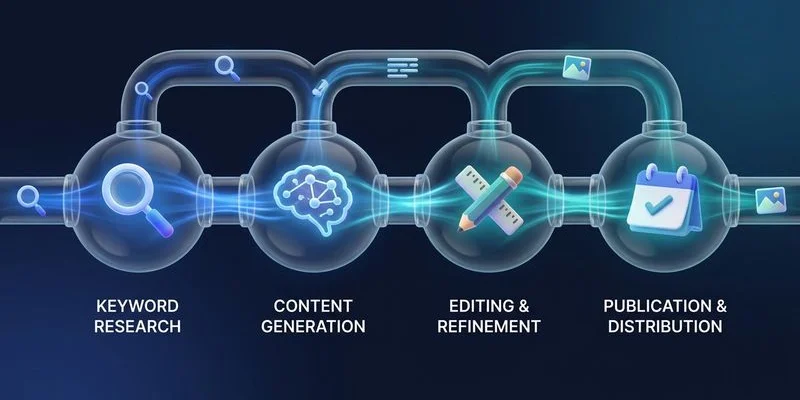
Moving from a small manual team to a high-volume pipeline requires a structured plan. We recommend dividing this transformation into four distinct weekly phases.
Phase 1: Keyword Research and Clustering (Week 1)
The process begins by building a comprehensive keyword list organized into tight topical clusters. We suggest using tools like Ahrefs or Semrush to identify search intent specific to the Malaysian market.
A single cluster represents a group of related keywords required to establish authority on one subtopic, and a proper silo linking strategy connects them effectively. Our most successful agency clients target 8 to 12 clusters for a standard 200-article batch.
Each cluster should contain 15 to 25 carefully selected keywords. We advise blending high-volume head terms with very specific, long-tail variations and question-based queries.
- Core Head Terms: Broad phrases identifying the main service or product category.
- Long-Tail Variations: Niche phrases capturing specific user problems or use cases.
- Question Queries: Common inquiries extracted from targeted industry forums.
- Location Modifiers: Specialized terms targeting local Malaysian cities and regions.
Phase 2: Batch Configuration (Week 1)
The next step involves uploading your organized CSV file directly into the platform. We require users to configure the critical batch-level settings before starting the generation run.
Marketers must define the exact internal linking rules to connect articles within the same cluster. Our system can automatically build these Silo Links if you provide your blog’s base URL.
- Content Parameters: Set the default guidelines for tone and format.
- Audience Definition: Define the target reader, such as homeowners or B2B software buyers.
- Model Selection: Select the optimal AI engine, like the standard GPT-4 setup.
- SEO Preferences: Configure technical preferences, including schema markup for FAQs.
Phase 3: Generation and Review (Weeks 2-3)
Initiating a large batch generation requires a bit of patience depending on your complexity settings. We typically see a 200-article queue take several hours to complete.
Project managers should actively monitor the progress dashboard as the system works. Our team recommends reviewing the first few completed drafts to spot-check formatting.
This mid-process review allows you to flag any pieces that need regeneration before the entire batch finishes. We encourage users to verify the tone consistency across different language outputs, especially if targeting both English and Malay readers.
- Length Verification: Verify exact word count targets are accurately met.
- Language Flow: Check the natural cadence of localized language phrasing.
- Structure Check: Ensure all required H2 and H3 subheadings are present.
- Citation Review: Confirm data points link to credible external sources.
Phase 4: Optimization and Publishing (Weeks 3-4)
Generated text still requires a final layer of optimization before hitting the live server. We remind users to verify that all title tags and meta descriptions are completely unique.
Content teams must add relevant media and schedule the posts across a realistic timeline. Our WordPress integration and API allows you to push these drafts directly to your CMS as scheduled posts.
- Linking: Apply final internal links between related cluster pages.
- Metadata: Verify uniqueness of all meta descriptions to prevent duplication.
- Media: Insert optimized alt text for every uploaded graphic.
- Scheduling: Assign publishing dates directly within the WordPress dashboard.
Avoiding Common Scaling Pitfalls
Pushing out massive amounts of text carries specific risks if managed poorly. We have identified four major traps that derail ambitious publishing schedules.
Pitfall 1: Uniform Content
Automated output naturally tends to feel homogeneous if left completely unchecked. We notice that articles often start the same way or lean on repetitive transitional phrases.
Marketers must combat this by varying the requested templates across different clusters. Our platform offers multiple introduction styles, from concise summaries to authoritative expert opinions, to keep the reading experience fresh.
- Intro Variation: Rotate through four different introduction styles.
- Format Alternation: Alternate between standard and detailed structural formatting.
- Expert Injection: Request custom fictional expert opinions for creative variety.
- Style Mixing: Blend numbered listicles with traditional narrative paragraphs.
Pitfall 2: Keyword Cannibalization
Overlapping keyword targets become a severe risk when managing 200 separate documents. We frequently see multiple articles accidentally competing for the exact same search query.
This internal competition severely dilutes the ranking potential of your entire domain. We strongly suggest manually reviewing keyword assignments during the clustering phase to ensure distinct targets.
Pitfall 3: Publishing Velocity Spikes
Dumping 200 new posts onto a site in a single afternoon looks highly unnatural to search engines. We advise distributing the publication dates evenly across several weeks or months.
A steady cadence of 10 to 15 articles per week gives Google’s crawlers adequate time to index the pages. Our internal data shows this measured approach prevents sudden scrutiny from algorithmic spam filters.
Pitfall 4: Neglecting Updates
High-volume publishing does not eliminate the need for ongoing maintenance. We teach our clients to build a strict quarterly review cycle into their workflow.
Editors must revisit older pieces to refresh outdated statistics and add links to newer guides. Our most resilient users treat their database as a living asset rather than a finished project.
The ROI of Bulk Production
The financial economics of automated writing are incredibly straightforward. We know that hiring an experienced freelance SEO writer in Malaysia typically costs between RM 250 and RM 850 per article.
Producing a batch of 200 pieces manually would demand RM 50,000 to RM 170,000 in monthly production costs. Our Bulk Mode slashes these expenses drastically by removing repetitive manual labor.
| Expense Category | Traditional Manual Production | Agility Writer Bulk Mode |
|---|---|---|
| Drafting Cost | RM 250 to RM 850 per article | Fraction of a cent per word |
| Turnaround Time | 3 to 5 days per piece | Under 10 minutes per piece |
| Formatting Labor | Manual styling and H2 placement | Automated structural templates |
These massive savings allow agencies to redirect their budgets toward high-value activities like link building and strategic planning. We believe that scale only becomes a true competitive advantage when paired with systematic validation.
High production infrastructure must always be guided by strict editorial standards. We are confident that this combination makes generating 200 pieces a month both highly profitable and sustainable.
Conclusion
Successfully Scaling Content Production with Bulk Mode: From 10 to 200 Articles Per Month transforms your entire business landscape.
We invite you to test these automated workflows within your own agency today.
Start building true topical authority and dominate your local search market.
Ready to Create Content That Ranks?
Start generating SEO-optimized articles with Agility Writer.
Try Us at $1