Silo Linking Strategy for SEO: How Internal Structure Drives Rankings
Learn how silo linking improves SEO rankings by creating clear topical hierarchies, and how to implement effective silo structures when producing content at scale.
Adam Yong
Founder & CEO

We see content teams pouring thousands of dollars into new articles every month, yet their traffic remains entirely flat. The problem rarely stems from the content quality itself. Most teams simply fail to connect their pages in a way that search engines understand.
Our founder, Adam Yong, built Agility Writer after spending nearly two decades in the SEO industry facing this exact frustration. He realised that scaling content production with an AI SEO writing platform without a solid internal architecture is like building a massive library without a catalog system.
This changes today.
We are going to break down the exact Silo Linking Strategy for SEO: How Internal Structure Drives Rankings. Let’s look at the data behind internal link equity, examine why random linking dilutes your authority, and walk through a proven method to organise your site for maximum visibility.
What Is a Silo Structure?
A silo is a highly organised group of related pages structured around a central topic. At the top sits a pillar page that provides broad coverage of the main subject. Below it, supporting pages address specific subtopics, questions, and long-tail variations.
Internal links flow vertically within this structure. The pillar links to the supporting pages, and the supporting pages link back to the pillar. Links also flow horizontally between closely related supporting articles.
We distinguish between two main types of organisation: physical silos and virtual silos. Physical silos rely on hard URL directories to group content. Virtual silos use strategic internal links to build topical relationships without changing the actual URL path.
| Feature | Physical Silos | Virtual Silos |
|---|---|---|
| Structure Basis | Hard URL directories (e.g., /category/post/) | Contextual internal links |
| Flexibility | Rigid and harder to change later | Highly adaptable as content grows |
| Implementation | Requires strict initial technical setup | Easily managed via content optimization |
The key principle is intentional connection. Pages within a specific cluster link freely to each other, but connections to different silos are strictly limited. A 2025 study by LinkStorm analysed 2.5 million internal links and found that less than 6% of contextual links reach a click depth of four or more. Keeping your related pages tightly grouped within three clicks of the homepage ensures search engines can actually find them.
Silo Architecture Example
Consider a home improvement website targeting the Malaysian market. A properly structured silo for a specific service area clarifies your exact expertise.
Recent 2025 data from digital agencies indicates that nearly 46% of Google searches now carry local intent. A well-structured silo captures that local search demand perfectly.
Here is what a localized home improvement silo looks like:
- Pillar page: Complete Guide to Kitchen Renovation in Kuala Lumpur
- Supporting: Best Kitchen Countertop Materials for Malaysian Weather
- Supporting: Kitchen Cabinet Styles and Costs in Selangor
- Supporting: Energy-Efficient Kitchen Lighting Design Tips
- Supporting: How to Plan a Terrace House Kitchen Layout
- Supporting: Kuala Lumpur Kitchen Renovation Cost Breakdown
Each supporting article links back to the main Kuala Lumpur pillar page. These pages also link to two or three other supporting guides within the exact same cluster. Links outside this specific group are rare. You would only link out to a bathroom renovation silo if it directly helps the reader solve a related problem.
Why Silo Linking Works
Topical Relevance Signals
Search engines use internal links to map the relationships between your URLs. When a tight cluster of pages all link to each other while sharing a common parent theme, the algorithm interprets this as deep, comprehensive coverage.
This concentrated linking directly strengthens your topical relevance. It sends a strong signal that satisfies Google’s E-E-A-T framework (Experience, Expertise, Authoritativeness, and Trustworthiness).
“Internal links are critical for establishing topical authority and guiding search engines through your most important content.” - 2026 seoClarity Analysis
Without a planned structure, your internal links spread ranking signals far too thinly across unrelated topics. A kitchen renovation article that links to a gardening tip sends completely mixed signals about its main focus.
A 2026 case study by seoClarity demonstrated the power of fixing this issue. A retail brand simply added targeted internal links to underperforming product pages, resulting in reclaimed top ranking positions and a 23% rise in total organic traffic. Contained linking keeps your relevance signals highly concentrated.
Authority Distribution
Link equity flows through your website via your internal link architecture. In a flat structure where every single page links to dozens of random URLs, this ranking power is completely diluted.
We recommend a more strategic approach to distributing this equity. A March 2026 analysis by Topical Map AI evaluated over 500 topical clusters and identified the “70-20-10 authority transfer model” as the most effective distribution method.
This model completely shifts how you should assign internal links:
- 70% of Equity: Directed to your high-converting money pages.
- 20% of Equity: Pointed to the main pillar page.
- 10% of Equity: Shared among standard supporting content.
Link placement also matters significantly. Industry data from Ahrefs shows that internal links placed within the first 100 words of an article transfer 15% more ranking authority than links buried at the bottom of the page. The silo structure ensures that when one supporting page earns an external backlink, that fresh ranking power flows efficiently to your most important related URLs.
Crawl Efficiency
Search engine bots rely on internal links to discover, crawl, and index your website. A clear architectural hierarchy creates highly predictable crawl paths.
Every website operates on a specific crawl budget allocated by Google. If your site structure is a messy web of dead ends, bots waste their limited time crawling unimportant or duplicate URLs.
Disorganised internal architecture frequently results in critical pages being orphaned or buried too deep to rank. Digital agency WebMetric released data in late 2025 showing that resolving these specific crawl and indexation problems can increase organic impressions by 30% to 60% without publishing any new content.
By clearly defining how your pages connect, a tight silo prevents crawlers from getting lost.
Implementing Silo Linking with Bulk Content
Step 1: Define Your Silos Before Generating Content
When producing content at scale with mass content creation tools, internal connections must be built directly into the production workflow. Retrofitting a logical structure onto hundreds of existing articles is a massive, expensive headache.
We always map out the exact hierarchy before generating a single word. This prevents the dreaded “content soup” phenomenon where a site becomes a confusing junk drawer of random topics.
- Identify your core topics using a tool like Semrush or Ahrefs to find high-volume head terms.
- List out the specific long-tail subtopics for each core theme to act as supporting pages.
- Define strict linking rules detailing which pages should connect.
- Identify a few intentional, cross-silo connections for related themes.
This planning phase determines the success of your entire campaign.
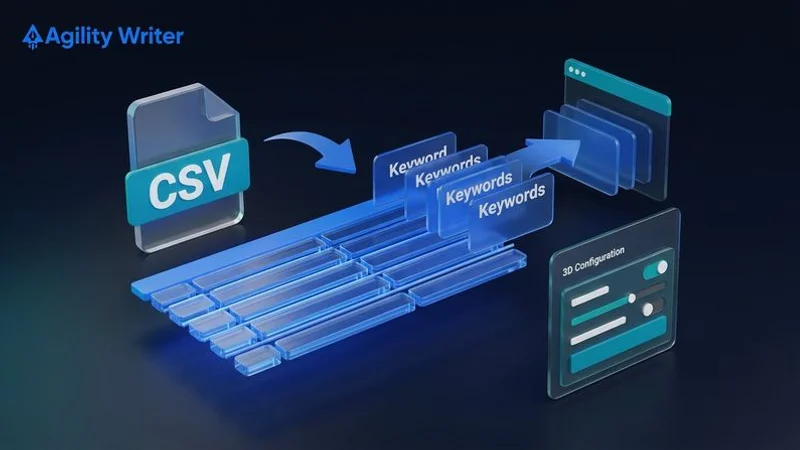
Step 2: Configure Linking Rules in Batch Settings
Setting up a bulk content generation batch requires specific parameters. You need to configure automated rules that accurately reflect your planned hierarchy.
Our team uses predefined batch settings to guarantee consistency across large content runs. This removes the manual guesswork from the linking process.
- Within-silo links: Each supporting article needs two to four links pointing to other pages in the exact same cluster.
- Pillar page links: The main pillar must include a direct link to every single supporting page in the group.
- Cross-silo links: Limit these external connections to one or two per article, and only use them if the transition naturally helps the reader.
Step 3: Use Anchor Text Strategically
The clickable words you use for an internal link provide vital context signals to search algorithms. Generic phrases waste a massive optimization opportunity.
Google Search Central documentation explicitly states that anchor text must clearly describe the linked page’s specific topic. Systems now use this text to understand the exact meaning of the destination URL.
- Use descriptive, keyword-rich anchor text instead of vague phrases like “click here” or “read more”.
- Vary the exact phrasing slightly across different articles to avoid triggering over-optimization penalties.
- Ensure the text seamlessly matches the grammatical flow of the sentence. Tools like LinkStorm can help scan your content to recommend context-rich anchors that make semantic sense.
Step 4: Audit and Maintain
Your internal architecture requires ongoing maintenance after you hit publish. As your site grows, older silos naturally degrade if left ignored.
We run comprehensive architectural audits every three to six months to keep our sites healthy. This ensures maximum efficiency for both users and crawlers.
- Use an auditing tool like Screaming Frog to verify that all planned links are functioning without redirect chains.
- Check for orphan pages that have zero internal links pointing to them.
- Identify fresh opportunities to add new supporting articles into existing, high-performing clusters.
- Remove or update any links pointing to outdated or consolidated content.

Common Silo Linking Mistakes
Over-Isolation
Some SEO professionals take this strategy to an extreme by refusing to place any links between different silos. This creates an artificially rigid website experience.
Cross-silo links provide massive value when they genuinely serve the reader’s immediate intent. The goal is highly intentional linking, not absolute isolation.
Industry experts often refer to this flexible approach as “soft siloing”. A soft silo relies on relevant internal links to build relationships, allowing for natural bridges between overlapping topics without diluting your core authority.
Ignoring User Intent
Internal links must serve real human navigation just as much as they serve search engine signals. A link that perfectly matches an algorithm’s preference but confuses an actual reader is a terrible link.
Every connection should present a natural next step for someone consuming the current page. If you force an unnatural link, users will simply leave.
High bounce rates and low time-on-site metrics often stem from misleading internal links. Google actively monitors these user engagement signals to determine if your page actually satisfies the search intent.
Flat Link Distribution
Giving every single page in your cluster the exact same number of internal links is a massive waste of potential. You must prioritise your highest-value URLs.
Your primary pillar page and your top-converting supporting articles require significantly more internal links than peripheral content.
Data shows that algorithms do not treat all links equally. Editorial links placed naturally within the body content carry far more weight than standard navigational links found in footers or sidebars.
Neglecting Updates
Existing silos demand constant updates as you publish new content. A static website slowly loses its competitive edge.
New supporting pages must receive inbound links from existing, established content within the same cluster. Conversely, your older pages need to link out to your newest additions.
Without this continuous maintenance, your Information Gain SEO Scores will drop. Search engines reward websites that actively keep their topical clusters fresh, interconnected, and highly relevant.
The Compound Effect
Silo Linking Strategy for SEO: How Internal Structure Drives Rankings is not a temporary tactic. Its impact compounds dramatically as your total content library expands over time.
Each new, highly relevant page you add to a properly structured cluster strengthens every other URL in that specific group. This creates an accumulating effect of concentrated topical authority.
Over several months, efficient link equity distribution builds a permanent ranking advantage that competitors cannot easily copy. For teams producing articles at scale using programmatic SEO with AI content, this architecture turns raw volume into genuine, lasting authority.
Take the time to map your topics today, audit your current link graph, and start building connections that actually move the needle.
Ready to Create Content That Ranks?
Start generating SEO-optimized articles with Agility Writer.
Try Us at $1